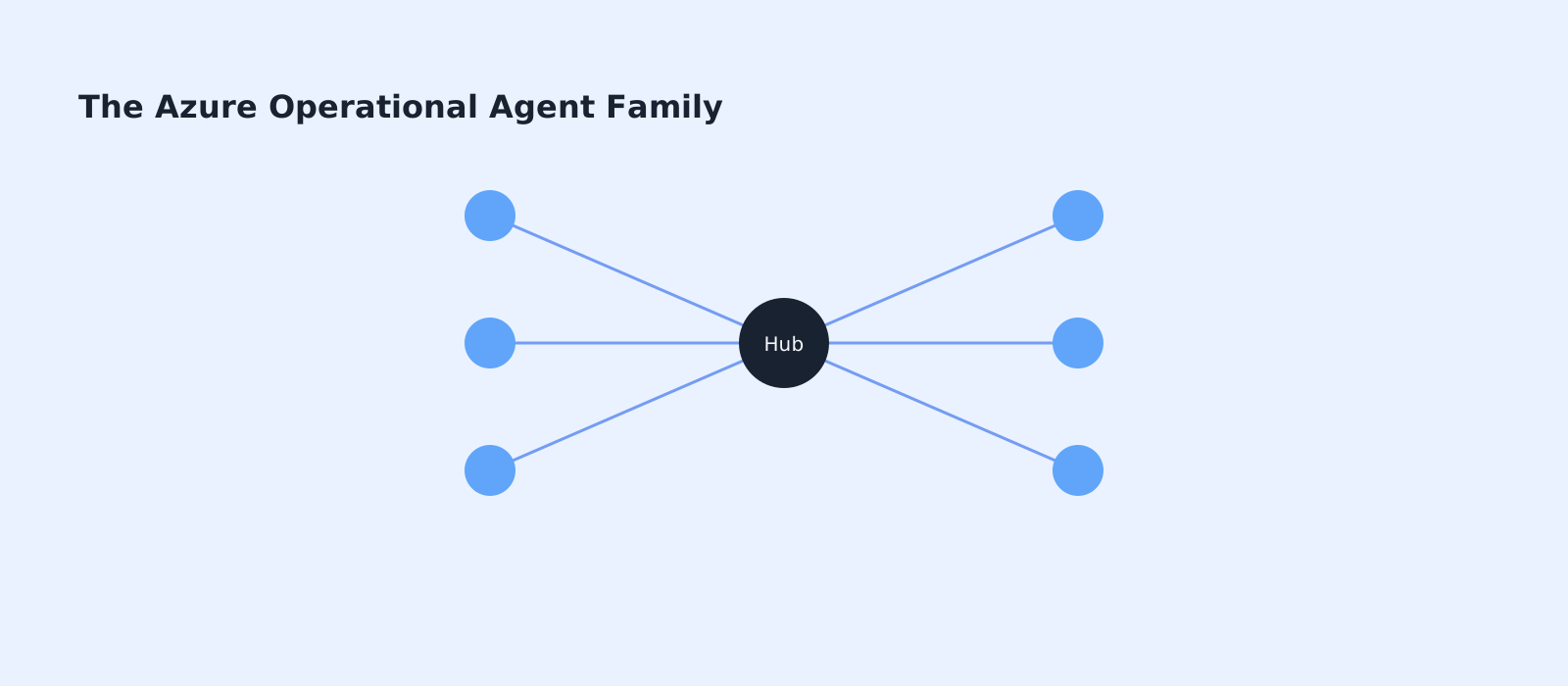
Azure has been shipping a growing family of AI-enabled operational agents — SRE-focused agents,
observability agents, troubleshooting agents — each aimed at a different slice of the “something
is wrong, what do I do” problem. This article is a working survey: what each agent family
actually does, where its documented scope stops, and where an operator would reasonably want to
extend it.
Research in Progress
This article is a living survey, not a finished evaluation. Sections below are marked where
deeper hands-on testing is still pending, consistent with the honest “Research in Progress”
label on this article rather than a claim of completed findings.
Why a survey, not a single deep dive
The individual agents overlap in places and diverge in others, and it is easy to reach for the
wrong one for a given incident if you have only read one product page in isolation. Laying them
out side by side, with the same set of questions asked of each, is more useful before committing
engineering time to any single one.
Questions asked of every agent
- What signal does it consume (metrics, logs, traces, topology)?
- What does its output look like — a suggestion, a runbook, an automated action?
- Where does its documented scope explicitly stop?
- What would a reasonable extension point look like for a team’s own runbooks?
What each agent family covers
SRE-oriented agents
Positioned around service-level reliability questions: is a service meeting its objective, what
changed recently, what is the blast radius of a given change. Strongest where telemetry is
already well-instrumented; weakest where the underlying signal is sparse or inconsistent.
Observability agents
Positioned around making sense of existing telemetry — correlating metrics, logs, and traces into
a narrower set of candidate causes. Useful as a triage accelerant; not a replacement for an
engineer’s judgment about which candidate cause is actually correct.
Troubleshooting agents
Positioned closest to a specific incident: given a described symptom, suggest likely causes and
next diagnostic steps. Most directly useful during an active incident; most dependent on the
quality of the initial symptom description.
Where extension points exist
Note — pending validation
The extension approach below is a design direction based on the documented agent APIs, not yet
validated end to end against a real incident. It will be updated once that validation exists.
A reasonable extension pattern layers an organization’s own runbooks and prior-incident history on
top of the agent’s built-in reasoning, rather than treating the agent as a closed black box. That
implies a data-connection story (get relevant internal documentation and past-incident notes in
front of the agent) more than a prompt-engineering one.
What this article does not yet claim
This survey does not report a completed head-to-head benchmark, a production deployment, or
measured incident-resolution time improvements. Those would require a controlled evaluation
methodology of the kind described in the companion
Enterprise Network Reliability Agent Evaluation
project, which is itself still at the evaluation-design stage.
Next steps
Run the agents referenced above against a small set of reproducible incident scenarios and update
this article with what was actually observed, replacing the “pending validation” sections above
with real findings.
 asharma.cloud